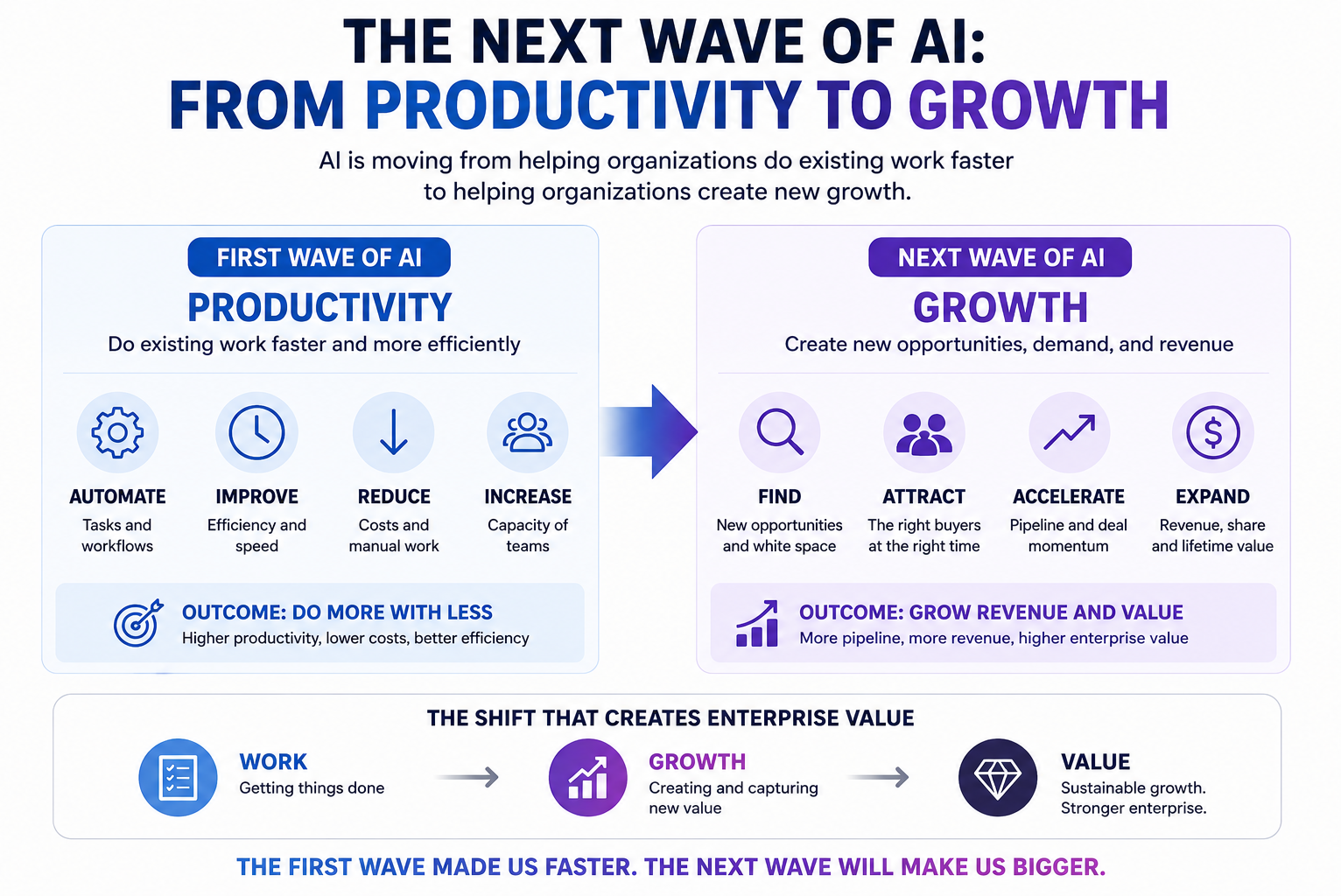
For three years the AI industry has been obsessed with productivity. Every week brings another copilot, assistant, agent, or digital worker — faster software development, more efficient customer support, better legal research, automated reporting, streamlined operations. And the vendors are right: AI is making organisations dramatically more productive. But productivity is only half the equation.
The question every CEO, managing partner, private-equity investor, and board member ultimately asks is not "how do we do the same work with fewer people?" It is "how do we grow revenue?" That single distinction may define the next decade of AI. While most of the market is focused on doing existing work faster and cheaper, a new category is forming around growth, revenue creation, customer acquisition, and market expansion. At Omnitech Capital, that is the bet.
The first wave of AI was productivity.
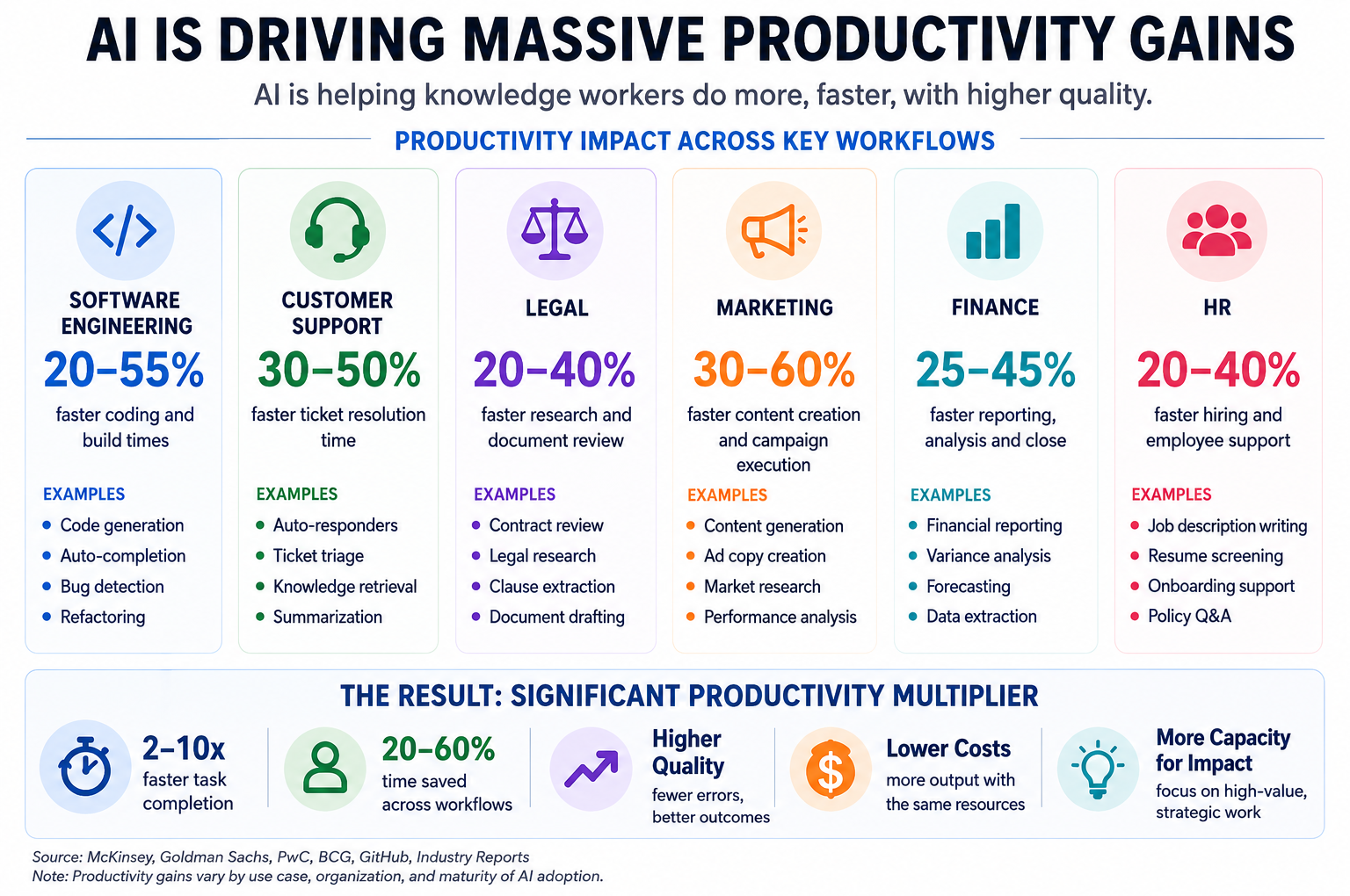
The first wave of AI has largely helped organisations perform existing tasks faster and cheaper. Software developers use it to write code. Lawyers use it to review contracts. Consultants use it to build presentations. Customer-service teams use it to answer tickets. Finance teams use it to generate reports. The results are real, and they are impressive.
GitHub has reported that software-development activity accelerated significantly as AI coding tools went mainstream. Technology leaders such as NVIDIA's Jensen Huang argue that AI is increasing developer productivity so dramatically that the world may ultimately employ more software engineers, not fewer. The important insight is that AI is not simply replacing labour — it is increasing economic output. But increasing output is not the same as creating growth. Productivity improves efficiency; it does not, on its own, create a single new customer.
The productivity trap.
Imagine a law firm. Today's AI can draft contracts faster, review documents faster, summarise regulation faster, and conduct research faster. All valuable. None of it answers a far more important question: where will the firm's next £10 million of revenue come from?
The same pattern holds across almost every industry. A logistics company can optimise routes. A bank can automate underwriting. An accounting firm can accelerate compliance reviews. A consulting firm can produce proposals faster. Yet none of these activities automatically creates new customers. Efficiency improves margins. Growth creates enterprise value — and for most organisations, growth remains the far harder challenge.
Productivity AI
Reduces costDoes existing work faster and cheaper. Improves margins and throughput. The deliverable is efficiency — the same output, with less input.
Revenue AI
Increases growthFinds customers, demand and markets that did not exist in the pipeline before. The deliverable is enterprise value — new revenue, not lower cost.
The missing layer in the AI economy.
The AI industry usually describes itself with a three-layer model — infrastructure, intelligence, and applications. Almost all venture funding and media attention has concentrated there. But a fourth layer is now emerging, and it is where AI moves from productivity to growth.
Where the funding sits — and where the gap is.
Layer four — call it Revenue Infrastructure — is made of the systems that help an organisation discover opportunities, identify buyers, build demand, accelerate sales, expand accounts, and create entirely new revenue streams. It is the smallest layer today and, we would argue, the most valuable one still unbuilt.
Why Revenue AI is different.
Productivity AI asks "how can we automate work?" Revenue AI asks "how can we create growth?" The change of question changes everything downstream — the data it needs, the way it is sold, and the budget it draws from. Here is what that question looks like in four very different industries.
The same question, four industries.
Where's the next matter?
Revenue AI identifies —Who's about to ship more?
Revenue AI identifies —Where's the value?
Revenue AI identifies —Who's in-market now?
Revenue AI identifies —The thesis: Data → Distribution → Deployment.
The most valuable AI companies of the next decade will not simply automate work — they will accelerate growth. Our thesis is built around the three assets that have historically decided market leadership, connected into a single chain that converts intelligence into revenue.
Together they form a model the market has not yet productised: Data → Distribution → Deployment → Growth. This is not a software platform; it is a growth platform, and it is the structure of the Omnitech Capital ecosystem — GTM Bench, GTM Bench Review, ENAI and their sister brands, each business strengthening the next. It also connects directly to the thesis this Review has built across recent issues on the great rewiring of the $500T economy and the unowned industry layer.
Four layers, one revenue engine.
Why boards care about growth more than productivity.
Every board meeting eventually comes down to four questions. Productivity contributes to one of them. Revenue growth influences all four.
This is why organisations consistently spend more on acquiring customers than on internal productivity tools — the budget attached to growth is usually far larger than the budget attached to efficiency. The companies that successfully connect AI to revenue outcomes will command the largest share of that spend.
From productivity AI to revenue AI.
The first decade of enterprise software digitised processes. The second automated workflows. The third introduced intelligence. The next decade will be about growth — and the winners will not simply own better models. They will own better data, better distribution, better deployment, better customer relationships, and better growth systems. The future of AI is not just about making organisations faster. It is about making them bigger.